Ualett
- 4.6
- Rating
- 500.00K
- Installs
- Free
- Price

 Analysis by App-foxy
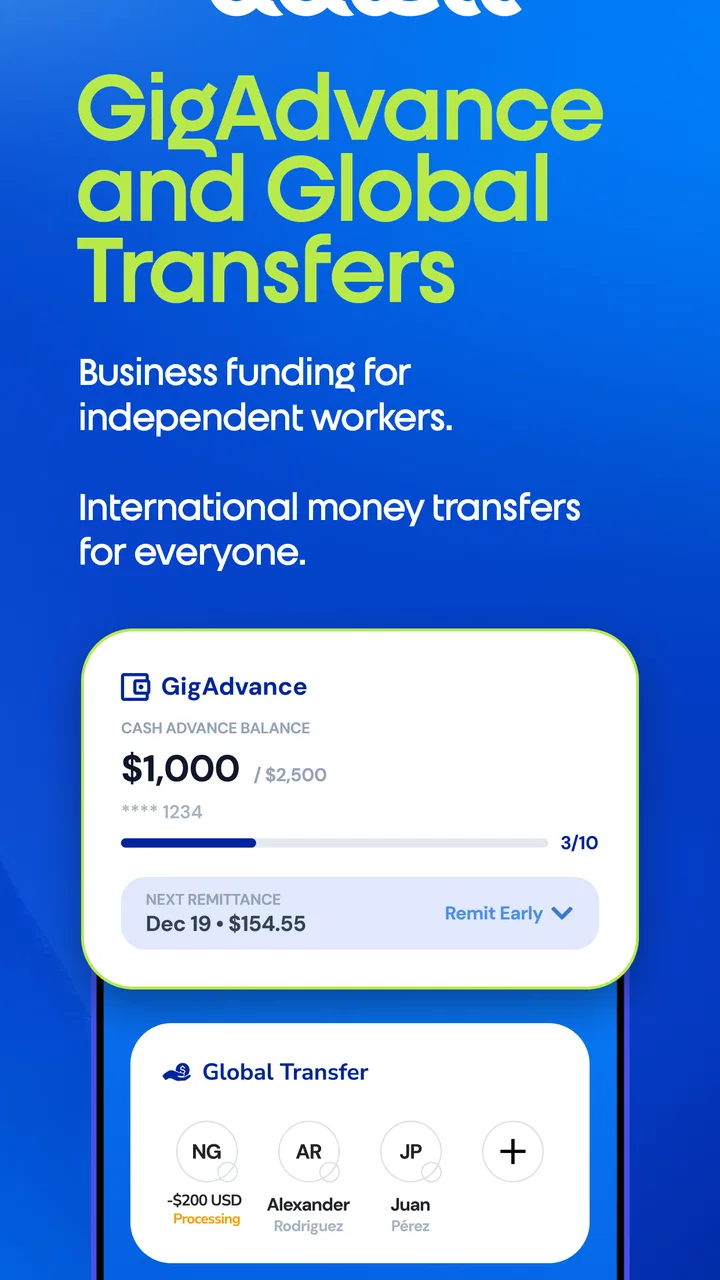
When income arrives through several gig platforms rather than a traditional payroll, the difficult part is often not earning money but managing the gaps between completed work and payday. Ualett is a free finance app from Cabicash Solutions, Inc designed around that situation. I approached it less like a general banking replacement and more like a practical tool for workers who need to think about cash flow on their own terms.
That distinction matters. A standard banking app usually assumes that money reaches your account on a predictable schedule. Gig work rarely behaves that way. A busy weekend, a slow week, fuel costs, or an unexpected bill can change the picture quickly. Ualett makes the most sense when the timing of your earnings is the main problem you are trying to solve, not when you simply want another place to view a balance.
My overall impression is positive, but I would not recommend installing it automatically just because you work independently. The right choice depends on how often your income arrives, how comfortable you are using a finance app for short-term planning, and whether you need a focused gig-worker experience or a broader money-management system.
You May Also Like

 Blood Strike: 2.5 Anniversary
Blood Strike’s Loadouts Turn Every Drop Into a Tactical Gamble
A close look at Blood Strike’s custom loadouts: how fast access to signature weapons reshapes its battle royale rhythm, rewards preparation, and narrows the gap between fights.

 Pandora - Music & Podcasts
Pandora’s Music Is Easy to Start, but Harder to Recover
Pandora’s strength is its low-effort path from a seed to a station. Its weak spot is how much confidence it asks you to place in connection, setup, and quiet recovery.

 8 Ball Pool
 Is Built on Rivalries, Rematches, and Routine
A close look at the rivalries, rematches, shared routines, and unanswered safety questions that turn a quick pool match into a persistent mobile community.

 Samsung Music
’s Quiet Strength Is Playing What You Already Own
Its reach comes less from spectacle than from dependable access to a personal library. That simplicity is both the app’s strongest retention engine and its ceiling.

 AccuWeather: Weather Radar
AccuWeather Review: A Quick, Clear Forecast for Everyday Decisions
For everyday plans, the best forecast is the one you can understand quickly. AccuWeather makes rain timing, radar, and local conditions easy to act on, with a few trade-offs.

 Hill Climb Racing
Why Hill Climb Racing Still Turns Crashes Into One More Run
A tiny car, a bumpy hill and one more upgrade: Hill Climb Racing keeps resurfacing because its simple chaos makes every near-miss feel personal.
More From Our News Desk



How I would decide whether Ualett fits
I would use this section to turn the fit question into a small, low-risk trial: identify one recurring cash-flow pinch point, then see whether Ualett helps me make that decision more clearly. The key is to judge the habit it supports, not just the relief of having another option in a tight moment. That leads naturally to a closer look at what its focused approach does better than other tools.
Start with the timing of your income
The first question I would ask is simple: do you regularly finish work before the money connected to that work becomes useful to you? If the answer is yes, Ualett has a clear reason to be on your shortlist. Its identity is built around gig workers, so the app feels more relevant to a driver, courier, freelancer, or other independent earner than a conventional account app that treats every deposit as a normal paycheck.
If your income already arrives on a reliable schedule and you rarely need to bridge a short gap, the benefit is less obvious. In that case, a regular bank app, budgeting tool, or spreadsheet may be enough. Ualett is most interesting when your financial life is shaped by irregular work rather than by a fixed monthly cycle.
Look at the kind of control you actually need
I would also separate two needs that are easy to confuse. One is visibility: knowing what money is available and where it came from. The other is access: having a way to deal with a cash-flow problem before your usual earnings settle. An app can be useful for the first need without solving the second, and the second can involve terms and responsibilities that deserve careful attention.
That is why I would read every screen during setup instead of tapping through quickly. Before relying on any finance service, I want to understand what I am agreeing to, what information is requested, how transactions are described, and what the practical cost of using the service may be. The free download does not automatically mean every possible financial action has no cost.
Think about your work pattern, not just your job title
“Gig worker” covers very different routines. Someone driving most days may need a tool that matches frequent earnings and frequent expenses. A freelancer who receives money only after completing a project has a different rhythm. A person combining delivery work with a part-time job may need a simple way to separate irregular income from predictable household money.
I found that Ualett is easier to justify when the app can become part of a repeatable routine. For example, I would check it after a work block, compare what I earned with what I still need for fuel and essentials, and decide whether I can safely move money toward a bill. That is more useful than opening it only when a financial emergency has already started.
Practical details that affect the decision
The app is free to install, is intended for everyone, and requires Android 8.0 or later. Those details make it accessible to many phone users, although compatibility still depends on the device and operating environment. It has been available since August 21, 2018, and the current version is 2.73.0, which shows that this is an established product rather than a brand-new experiment.
Its public reception is also encouraging: Ualett holds a 4.6 average from around 7,600 ratings, with roughly 1,300 written reviews and over 500,000 installs. I treat those figures as a useful sign of adoption, not as proof that every user will have the same experience. Finance apps can work well for one person and feel restrictive to another because their income patterns and expectations are different.
A realistic day-to-day example
Imagine I spend the morning completing delivery work, then need fuel before accepting another busy period. My next normal payout may not line up with the moment I need to refill the tank. In that situation, I would use Ualett as part of a cash-flow check: review what I have earned, consider the immediate expense, and make sure I am not treating a temporary solution as extra income.
The important habit is to calculate the full picture. Fuel, meals, vehicle maintenance, taxes, phone service, and personal bills all compete for the same earnings. An app aimed at access to money can make a tight moment feel easier, but it cannot turn gross gig revenue into take-home pay. I would keep a separate running estimate of work expenses and tax obligations instead of relying on the app alone.
Where Ualett stands out, and where another option may be better
Here I would compare the app by the job I need done, rather than treating every finance tool as interchangeable. A gig-focused service may suit uneven earnings, while a bank, budgeting app, or spreadsheet can be stronger for other routines. I would also weigh whether the added check-in becomes a useful monthly habit or simply another account to maintain.
The strongest advantage is its narrow focus
Ualett’s biggest strength is that it does not present itself as a generic personal-finance product. The developer, Cabicash Solutions, Inc, has positioned it for people whose earnings come from gig work. That focus changes the starting point of the conversation. Instead of asking a worker to adapt a traditional payroll model to irregular income, the app begins with the irregular income problem.
That can reduce mental friction. A general bank application may show balances and transactions perfectly well, yet still leave me asking how to handle a payout that arrives later than expected. A basic budgeting app may help me categorize spending but give little practical help when the timing of earnings is the urgent issue. Ualett is more appealing when that timing question is at the center of my decision.
It can support a more deliberate cash routine
One non-obvious benefit is the possibility of using the app as a checkpoint before taking action. Gig work encourages quick decisions: accept another job, spend money on fuel, cover a bill, or keep working longer. I would use Ualett to slow that process down. Before treating available funds as permission to spend, I would ask what portion belongs to upcoming costs and what portion is genuinely flexible.
This is a small workflow, but it is valuable. The app should not be viewed as a replacement for a ledger. Instead, I would pair it with a simple note containing weekly fuel, maintenance, tax, and household targets. That combination gives the app context and helps prevent a common mistake: confusing access to money with an increase in earnings.
Where a standard bank app remains stronger
A traditional bank is usually the better primary home for long-term money management. It may be more familiar for recurring bills, savings, direct deposits, account history, and everyday spending. If my main goal were to build a stable emergency fund, organize several household accounts, or manage a conventional salary, I would start with a bank rather than a gig-focused service.
I would also prefer a standard banking relationship when I need a broad set of established financial tools in one place. Ualett can complement that setup, but I would not assume that a specialized cash-flow app should replace every account I already use. Keeping the roles clear is safer: one service for ordinary banking, another for a specific gig-income problem if that problem is real and recurring.
Where budgeting apps and spreadsheets may win
If I mainly struggle with overspending, a budgeting app may offer better value because its central job is planning categories and tracking habits. If I want maximum flexibility, a spreadsheet can be surprisingly effective. I can record each gig, subtract fuel and other work costs, reserve an amount for taxes, and see what remains without adding another financial service to my routine.
That approach takes more discipline, but it has one major advantage: I control the structure. Ualett is a better fit when I want a purpose-built experience connected to gig-worker cash flow. A spreadsheet is better when my situation is unusual, my income comes from many sources, or I want to model several future scenarios in detail.
Where an employer-linked earnings tool may fit better
Some workers receive income through a particular platform that offers its own payment timing or financial tools. When that option is tightly integrated with the work platform, it may require fewer steps and provide a more direct view of the relevant earnings. In that case, I would compare convenience carefully rather than assuming a separate app is automatically superior.
Ualett’s broader gig-worker positioning may be more useful to someone who works across different platforms, but a platform-specific alternative could be simpler for a person who earns almost everything from one source. The trade-off is between wider relevance and tighter integration. I would choose based on my actual work mix, not on the most attractive description.
Limitations I would take seriously
The first limitation is behavioral. A tool that makes money feel available sooner can encourage me to spend before I have accounted for the next expense. This is especially risky for gig workers because earnings are not the same as profit. I would never use Ualett without keeping a separate reserve for taxes, maintenance, and slow periods.
The second limitation is that specialized finance products require careful reading. I would inspect the terms attached to any advance, transfer, repayment, or other action before confirming it. The word “free” describes the app’s price, not necessarily every financial service accessed through it. If I could not understand the total obligation in plain language, I would stop and look for clarification.
The third limitation is dependence on a phone-based workflow. If my phone is damaged, offline, low on battery, or unavailable during a workday, I still need a backup way to track earnings and expenses. I would keep basic records outside the app and avoid making it the only place where important financial information exists.
What switching to Ualett really involves
The cost of switching is not just the time spent installing an app. I would need to change my routine, learn how the service presents available funds, connect it mentally with my work schedule, and decide which account remains responsible for ordinary bills. If I already have a reliable system, adding Ualett may create another screen to monitor without solving a serious problem.
For someone moving from no system at all, the switch can be worthwhile because it creates a dedicated place to think about gig income. I would begin with one limited use case rather than moving everything immediately. For example, I might use it to review cash flow after work sessions while leaving savings and recurring payments in my existing bank account. After a few weeks, I could judge whether it genuinely reduces stress or merely adds complexity.
Who should skip it
I would skip Ualett if my income is stable, my bank already handles my needs comfortably, and I have no recurring timing problem. I would also be cautious if I tend to use short-term access as a substitute for budgeting. In that situation, a spending plan and emergency reserve are likely to help more than another way to reach money.
It may also be the wrong choice for someone who wants a full financial dashboard, detailed investment management, extensive household budgeting, or a single account for every purpose. Ualett’s value comes from its focus. That focus is an advantage for the right user and a limitation for someone looking for a complete financial ecosystem.
Who I would recommend it to
I would recommend trying Ualett to a gig worker who repeatedly has useful earnings arriving at inconvenient times and wants a service designed around that reality. I would be especially interested if I worked across more than one gig source or found that a conventional bank app did not help me think through irregular payouts.
I would treat it as a supporting tool, not as permission to increase spending. My preferred setup would keep long-term savings, bill money, and tax reserves in their normal places while using Ualett for the short-term cash-flow decisions it is meant to address. That separation makes the app easier to evaluate and limits the damage if my work income drops unexpectedly.
My final recommendation
After weighing the alternatives, I see Ualett as a focused finance app rather than a universal banking answer. Its free price, broad accessibility, established presence, and strong user reception make it reasonable to consider, especially for people whose earnings come from gig work and do not arrive on a neat schedule.
My recommendation is conditional but clear: try it if irregular payout timing is a genuine daily problem, and test it with a defined routine instead of using it impulsively. Keep a separate record of expenses and reserves, read the terms before using any money-access feature, and compare its convenience with the tools you already trust.
If your main need is ordinary banking, detailed budgeting, or long-term financial planning, I would choose a conventional bank app, budgeting tool, or spreadsheet first. If your main need is making irregular gig income easier to manage between work and payout, Ualett deserves a closer look. Its best use is not replacing financial discipline; it is giving that discipline a workflow that matches gig work.
FAQs for Ualett
01What is Ualett and what can I use it for?
Ualett is a mobile financial service designed to help users manage everyday money tasks from a smartphone. Depending on your location and eligibility, it may provide features such as digital account management, payments, transfers, card-related services, and access to financial tools. Available functions can vary by country, so review the current app description and terms before registering.
02Who can create a Ualett account, and what documents are required?
Account availability depends on your country, age, residency, and Ualett’s current eligibility requirements. During registration, the app may ask for personal information and identity verification documents, such as a government-issued ID, along with a phone number or email address. Make sure your details are accurate, because incomplete or mismatched information can delay verification or restrict access.
03Is Ualett safe to use for payments and financial transactions?
Ualett uses account security and identity-verification procedures intended to protect user information and transactions, but no financial app is completely risk-free. Use a strong, unique password, enable any available security features, and never share verification codes or login details. Before making important transactions, check fees, recipient information, privacy policies, and the applicable terms.
04Are there fees, limits, or additional charges when using Ualett?
Some Ualett services may be free, while others can involve transaction fees, withdrawal charges, exchange-rate costs, card fees, or account limits. The exact pricing and limits may depend on your country, account type, verification status, and the specific service used. Check the fee schedule inside the app or on the official website before confirming a transaction.
05What should I do if I cannot log in or a transaction is delayed?
If you have trouble accessing Ualett, first check your internet connection, update the app, and use the official password or account-recovery process. For delayed or failed transactions, review the transaction status and avoid repeating the payment until you understand what happened. If the issue continues, contact Ualett support through the official in-app or website channels and keep any reference number.
Pros
- Fast access to earned wages through the mobile app
- Simple interface makes balance and payment details easy to check
- Useful for managing cash flow between regular paydays
- Digital application process can save time and paperwork
- May help cover unexpected expenses without a traditional loan
Cons
- Availability may depend on employer participation and eligibility rules
- Early wage access can reduce the amount in your next paycheck
- Fees may apply depending on the withdrawal method or plan
- Not intended to replace stable income or long-term financial planning
- Support and transaction processing may be limited outside business hours

Ualett
Gallery